
Senator Eldridge Joins Hundreds of CDC Advocates to Keep MA Families in their Homes & Protect Vulnerable Communities
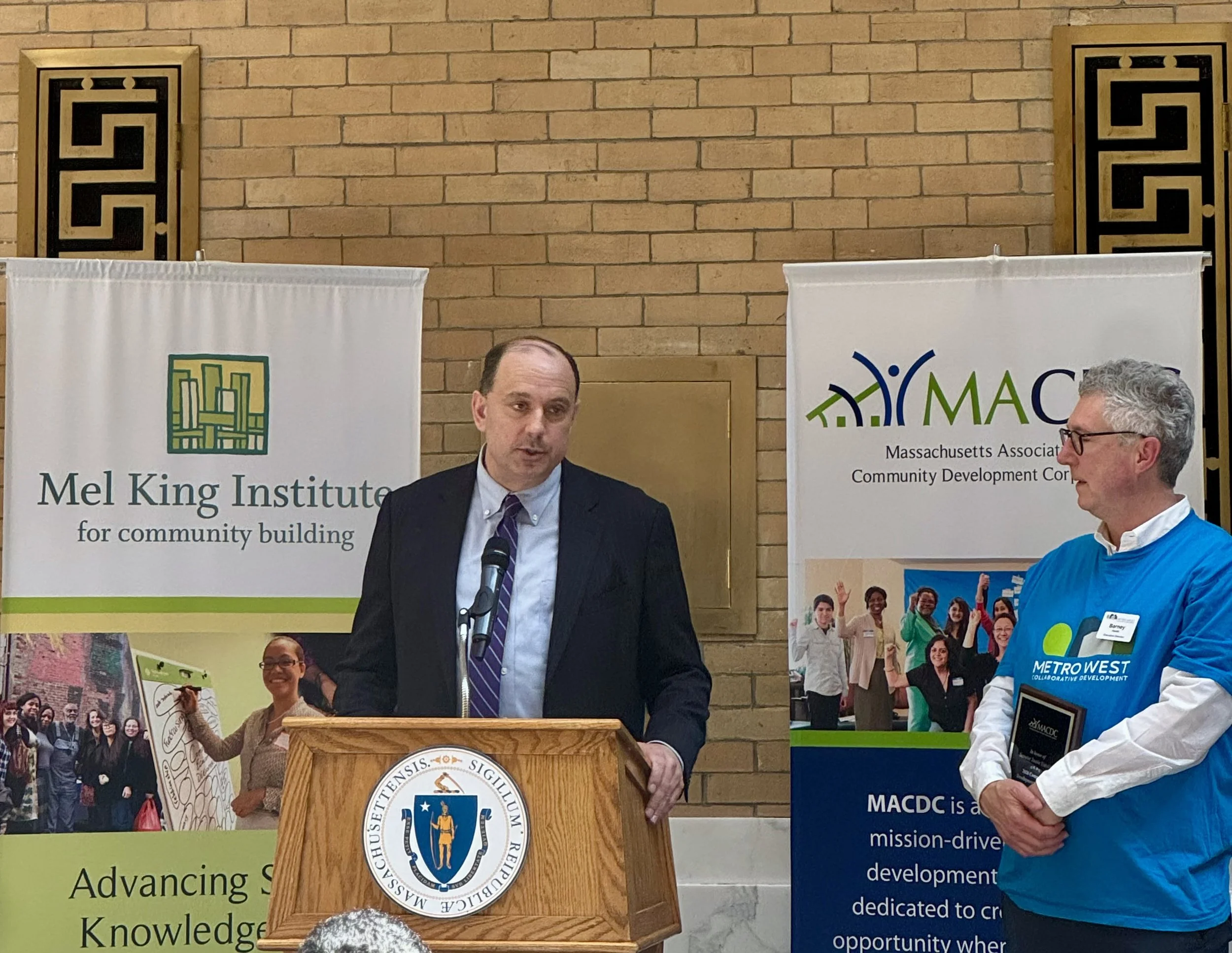
Boston, MA — The Massachusetts Association of Community Development Corporations (MACDC) brought over 250 community development leaders to the State House today for their annual Lobby Day, rallying around a unified message: Massachusetts must do more to keep residents in their homes, support its most vulnerable communities, and ensure that economic opportunity reaches everyone. CDC leaders from across the Commonwealth met with legislators to advance four priorities — the Tenant Opportunity to Purchase Act (TOPA), the PROTECT Act, the Small Business Technical Assistance (SBTA) grant program, and the Chapter 206 Foreclosure Prevention Counseling program.
The agenda reflects an urgent moment. Foreclosures have risen since the pandemic while federal housing supports continue to retreat. Hot real estate markets are driving displacement of renters — disproportionately households of color, seniors, people with disabilities, and low-income families. Small businesses owned by entrepreneurs of color and those from immigrant families are struggling against rising costs and shrinking federal support. And immigrant communities face intensifying state violence.
“As the federal government continues to threaten critical state funding and many families across the Commonwealth struggle to keep up with rising costs, the work of community development corporations has never been more important,” said Attorney General Andrea Campbell. “I’m grateful for MACDC’s continued partnership to protect immigrant communities, preserve affordable housing, and increase opportunities for our kids. I look forward to continuing to work together to make Massachusetts a better place to live and work for everyone.”
Representative Samantha Montaño (Boston), who worked at a CDC prior to their time in the legislature, added “MACDC understands our communities are stronger when folks can stay and thrive. This legislative agenda speaks to the importance of their work and the vitality of community in that work. I’m proud to have been shaped by this world and the people in it.”
Preventing Displacement: Keeping Families in Their Homes
Two of MACDC’s priorities directly address the displacement crisis facing Massachusetts renters and homeowners. Together, TOPA and Chapter 206 Foreclosure Prevention Grants target both ends of the housing stability spectrum — one empowering tenants when their homes go up for sale, the other helping homeowners avoid foreclosure before it’s too late.
Tenant Opportunity to Purchase Act (TOPA) — S.998 / H.1544
Sponsored by Senators Jehlen and Gomez and Representatives Livingstone and Consalvo, TOPA would give municipalities the option to grant tenants in multifamily buildings the right to match a third-party offer when their homes are being sold. Tenants may also designate that right to a nonprofit, local housing authority, or affordable housing purchaser — leveling the playing field against the real estate speculation that drives displacement.
“TOPA is a local option bill that can help municipalities create long-term housing affordability, while ensuring that landlords get full market price when selling their buildings — a win-win. I appreciate MACDC’s support and partnership on it” said Representative Jay Livingstone (Boston).
The bill is carefully designed to protect small landlords (those owning nine or fewer units in a municipality are exempt), preserve market-rate sales with no price restrictions, and mirror normal financed real estate transaction timeframes. It is revenue-neutral, and gives cities and towns a powerful, flexible tool to address their own local housing needs.
Chapter 206 Foreclosure Prevention Counseling — FY27 Budget Ask: $3.05 Million (Line Item 7006-0011)
For homeowners, the threat of displacement often arrives not through a sale but through financial hardship. The Chapter 206 Grant Program funds 24 nonprofit housing counseling organizations statewide that provide one-on-one coaching and group classes to help first-time homebuyers navigate the process and help homeowners facing hardship avoid foreclosure. Since the program’s creation, Massachusetts foreclosure rates have stayed on average 64% below the annual national rate — and the program has served over 109,000 homebuyers and homeowners.
“Massachusetts is a leader in protecting homeowners and prospective homeowners from the predatory lending and foreclosure practices of banks,” Senator Jamie Eldridge (Acton) stated. “The Chapter 206 foreclosure prevention grants are critical to ensuring that homebuyers understand the terms of their mortgages and that homeowners know how to avert foreclosure when times get tough.”
But funding has been cut by 50% over the past two fiscal years. The Division of Banks back-filled the gap from its Trust Fund, but that fund is now empty. MACDC is calling for restoration to $3.05 million in FY27. Chapter 206 has a dedicated revenue source from DOB fees and is the only state funding of its kind in Massachusetts. Without it, first-generation homebuyers and those on the brink of foreclosure lose a critical resource at exactly the wrong moment.
“Community development is about dignity. It’s about ensuring that every person has the opportunity and support to buy a house, start a business, or just to remain in a community where they can thrive,” said Senator Jo Comerford (Northampton). “I am grateful to the CDCs across the Commonwealth that are strengthening local economies and building more resilient communities.”
Supporting Vulnerable Communities: Economic Opportunity and Equal Protection
MACDC’s two other priorities address the economic and civil rights dimensions of community stability. SBTA invests in entrepreneurs who have historically been shut out of business and capital networks. The PROTECT Act ensures that immigrant residents — many of them the same families CDCs serve every day — can access the courts, their workplaces, and public services without fear of ICE violence.
Small Business Technical Assistance (SBTA) Grant Program — FY27 Budget Ask: $7.5 Million
The SBTA grant program funds nonprofits across the state that help entrepreneurs start, stabilize, and grow their businesses — with a deep focus on entrepreneurs of color, veterans, and those from immigrant families. Its track record is remarkable: thousands of new businesses created, tens of thousands of jobs created or preserved, nearly $10 in federal and private capital leveraged for every $1 invested in the program.
Despite that return on investment, SBTA funding was cut 33% in FY26, even as small businesses face escalating insurance costs, high real estate prices, and the withdrawal of federal supports. SBTA providers are on the front lines, helping entrepreneurs find creative solutions and ensuring every small business owner has the capital and networks to thrive. Restoring funding to $7.5 million is a high-return investment in the Commonwealth’s main streets economic vitality.
Ingrid Tucker, Executive Director of Codman Square NDC, an SBTA provider, said: “I recently had the opportunity to attend our SBTA graduation which culminated a series of 14 classes for local residents. The participants shared how much they learned in the process, and several have already launched their businesses, attributing their growth to the program and the unwavering encouragement from Naldo, our SBTA Coordinator. They learned to develop business plans and were held accountable. A longtime resident said it feels good being from Codman Square and having a business here! This is something they want their family and future generations to enjoy. This is why we need support for small businesses. The feel they couldn’t have done this alone.”
PROTECT Act — H.5316
Championed by the Massachusetts Black and Latino Legislative Caucus, the PROTECT Act (An Act promoting rule of law, oversight, trust, and equal constitutional treatment) would establish clear, enforceable protections for immigrant communities across the Commonwealth. CDCs serve immigrant families every day — in their homes, their businesses, and their neighborhoods — and the fear and uncertainty pervading those communities profoundly undermines their economic, family, and civic life.
The PROTECT Act keeps local law enforcement focused on local public safety rather than civil immigration enforcement. It prohibits civil immigration arrests in courthouses without a judicial warrant; protects survivors seeking U/T visa certifications; strengthens due process for immigration detainees at Massachusetts facilities; and requires employers to notify workers within 48 hours of any I-9 audit. The Attorney General would have centralized authority to enforce all protections. These are common-sense guardrails that uphold the rule of law and protect every resident’s right to equal protection.
“Community Development Corporations are an essential resource for small businesses across the Commonwealth,” said Representative Andy Vargas (Haverhill), Chair of the MA Black and Latino Legislative Caucus and House Chair of the Joint Committee on Community Development and Small Business. “I’m honored to be recognized by MACDC with a Community Development Champion Award. MACDC has been an invaluable partner in our work on the Joint Committee on Community Development and Small Businesses and with the Black and Latino Caucus, helping ensure that underserved communities and minority-owned businesses continue to have access to technical assistance, capital, and fundamental due process. At a time when many of the most vulnerable members of our community are being targeted because of their background or status, MACDC and its partner organizations are working at every turn to ensure those communities are protected and not left behind.”
# # #